Let's talk about printed Glock switches

First and most important, they do work, at least for a time. They will not last as long as a metal version, but they are a small item to print, so the durability of them is not an issue. Once the blade of the Glock switch wears down, the firearm is still functional as well, just in it's standard semi-automatic function.
There are two main versions of the Glock switch. The one I see most often is the one pictured to the left. This Glock switch creates an obvious protrusion from the back of the slide. There is a second option called the "Invisi-switch" that is much less obvious, as it sits flush with the back of the slide, just like the slide cover plate that it replaces.
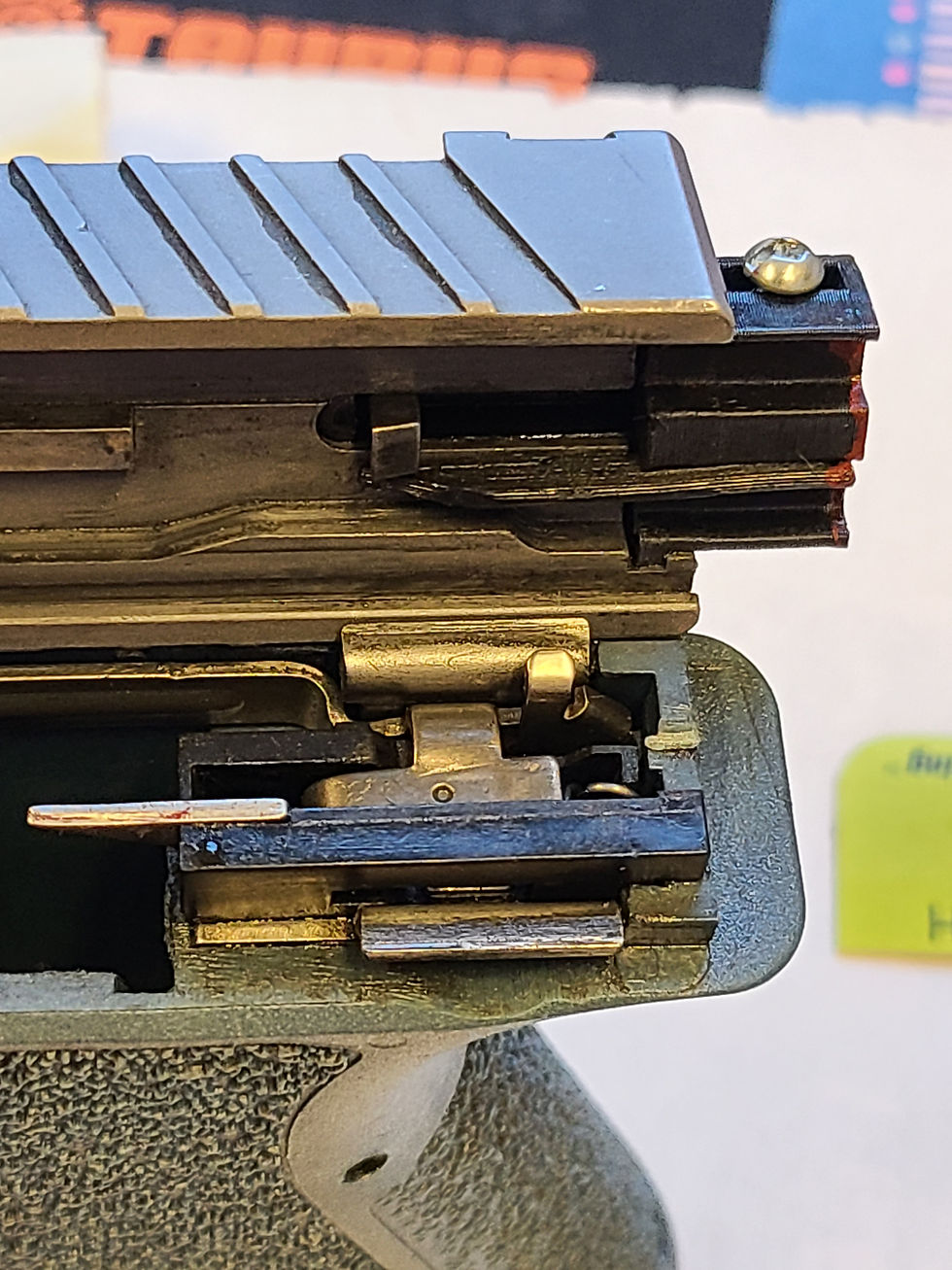
It functions by having a blade that pushes the trigger bar down just as the slide and barrel lock together, releasing the striker, and firing the next chambered round. As long as the shooter keeps the trigger depressed and there is ammunition in the magazine, the pistol will keep firing at a high rate of fire. Unless the shooter is practiced, accuracy is going to be an issue, especially if there is no shoulder support. To me, this means more shots going into the background and more unintentional targets being hit. When used in a criminal setting, this means more bystanders being put in danger as the shooter hits everything but their intended target.
There is a version of this type of object for several different firearms. AR-type firearms have had easy to install "drop-in auto sears" for a while as well, but they have not gained as much attention as the Glock switches. I do think the time of the Glock switch will be coming to an end eventually, as developers have been working around Glock trying to redesign their pistols away from the very easy installation of Glock switches. The next design, that accomplishes a similar outcome but through a different function, are "forced reset triggers" or FRTs.

To the left you'll see a 3d printable model for a Glock FRT. There are many versions, and like the Glock switch, there are metal versions as well. This is again a small part to 3d print. So, while the plastic will wear down, you could print several of these at a time per build plate and just keep swapping them out at a cheap cost.
These function differently. The function of the pistol is going to force the trigger back forward (thus a forced reset trigger) even with some rearward force applied by your finger pulling the trigger. It pushes the trigger forward enough that it resets the connector (or disconnect depending on the verbiage you use) and as long as the shooter continues to apply rearward pressure and there is ammunition in the magazine, the pistol will continue to fire at a high rate. At least currently, this seems to be in a legal grey area, getting around the definition of machine gun that the Glock switch carries with it (yes, each Glock switch would be considered a machine gun, even if it is not currently installed in a Glock-like pistol).
In my opinion, Glock switches and similar designs will likely be replaced by these FRTs eventually. But both of these will continue to be relevant into the future for firearms examiners, and should be added to your knowledge base.


Comments